

Table of Contents: Cast Iron Plant
| Plant Metric | Profile Data |
|---|---|
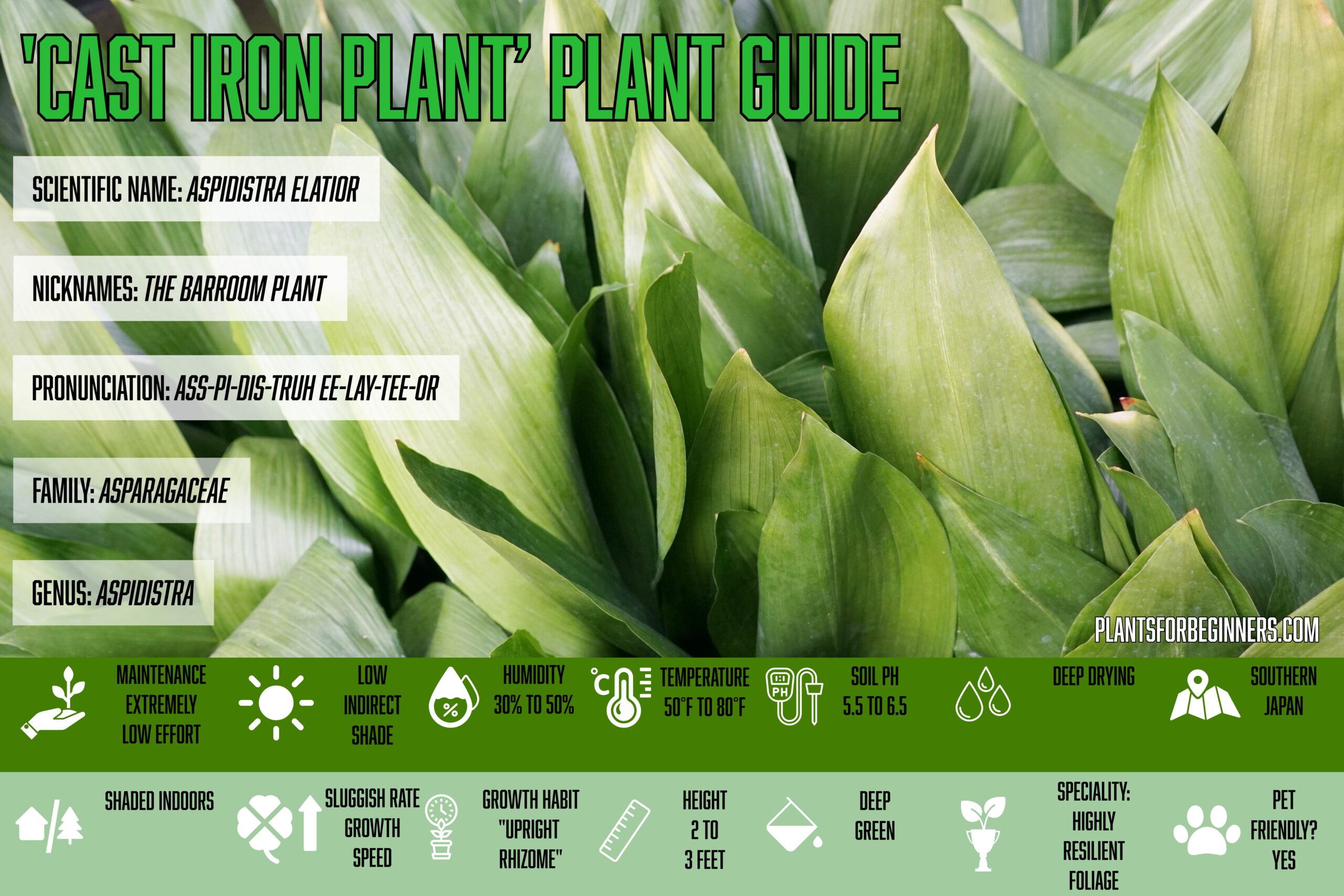
| Binomial Plant Name | Aspidistra elatior (Cast Iron Plant) |
| Type | Foliage Houseplant |
| Genus | Aspidistra |
| Pronunciation | ass-pi-DIS-truh ee-LAY-tee-or |
| Meaning Behind Name | From the Greek aspidion (a little shield), referring to the shield-like shape of its flowers or stigma. |
| Nicknames | Bar-Room Plant, Iron Plant |
| Commonly Confused With | Spathiphyllum (Peace Lily) or Calathea, which have similar dark green, lance-shaped leaves but vastly different care needs. |
| Variants of Plant | ‘Variegata’ (white striping), ‘Milky Way’ (white spotting), and ‘Asahi’ (white leaf tips). |
| Temperature | 50°F to 80°F (10°C to 27°C) |
| Light | Low to moderate, indirect light |
| Watering | Allow the soil to dry out significantly between waterings. |
| Humidity | Adaptable; thrives in low to average indoor humidity (30% to 50%). |
| Soil pH | Slightly acidic to neutral (5.5 to 6.5) |
| Blooming Season | Rarely blooms indoors; produces inconspicuous purple flowers at the soil line in spring. |
| Lifespan | 50+ years |
| Growth Speed | Exceptionally slow, typically producing only 2–4 new leaves per year. |
| Pet Friendly | Yes (Non-toxic to cats and dogs) |
Plant Overview
The Cast Iron Plant (Aspidistra elatior) is an upright, clump-forming foliage plant known for its thick, leathery, lance-shaped leaves that can withstand extreme indoor neglect. Highly regarded by beginners for its incredibly resilient nature, this Japanese woodland species brings a timeless, lush green aesthetic to dark indoor corners without the fussy requirements of traditional tropical houseplants. Because it grows at a very slow pace and easily survives periods of drought, poor air quality, and low lighting, it is the ultimate option for busy plant parents or dim apartment spaces that crush more delicate varieties.

Beyond its striking toughness and easy care, this architectural plant carries a rich cultural legacy, historically serving as a status symbol of resilience in Victorian-era parlours where it survived coal-smoke air pollution. Often valued today for its structural simplicity and excellent air-purifying qualities, it fits seamlessly into contemporary minimalist or dark-walled interior designs. As a slow-growing specimen, it maintains its elegant shape for years without rapidly outgrowing its assigned space, making it highly reliable for decorative floor styling. It offers a stress-free canvas for urban dwellers who want the visual warmth of vibrant greenery without the daily chore of high-maintenance monitoring.
Native Climate & Indoor Placement
The Aspidistra elatior evolved as a classic understorey specimen on the cool, heavily shaded forest floors of southern Japan. Living beneath dense evergreen tree canopies taught this plant to utilize minimal light with extreme cellular efficiency. Replicating this native forest floor indoors means shielding the wide foliage from direct sunbeams to prevent irreversible leaf bleaching.

Window Orientation: Position the plant directly in a North-facing window or 3 to 5 feet away from an East-facing window.
Deep Room Placement: It can safely sit up to 10 feet away from a bright South or West window, making it perfect for dim hallways or office corners.
Temperature Ranges: Thrives in standard household environments between 50°F and 80°F (10°C to 27°C).
Winter Minimums: It is highly cold-tolerant and can survive brief drops down to 45°F (7°C), but it must be kept safe from freezing frost.
Draft Warnings: Keep the plant isolated from the bone-dry, direct blast of central heating vents, localized fireplace heat, and heavy air conditioning currents.
Care & Seasonal Maintenance
Managing the hydration of this resilient species requires a complete shift away from rigid calendar schedules. Because its metabolic clock runs incredibly slowly, the plant processes water at a fraction of the speed of standard household greenery. Its thick leaves feature a heavy, protective waxy cuticle designed to seal in internal moisture and resist harsh environmental stressors.
Forcing frequent watering routines on a slow-moving organism will rapidly saturate the potting medium, creating anaerobic conditions that drown the roots. Successful care means applying deep, thorough waterings only when the soil column has dried substantially from top to bottom. This mirrors natural forest rainfall cycles and prompts the plant to maintain a resilient, deep root network.

Lighting Thresholds for Cast Iron Plant
While placement away from bright windows is fully acceptable, monitor the broad foliage to ensure the light levels are balanced. Healthy foliage maintains a uniform, deep forest-green hue across its wide surfaces. If the leaves turn pale green and new leaf stalks emerge looking weak, elongated, and floppy, the plant is signaling light starvation. Conversely, if you notice bleached, papery white or straw-coloured patches spreading across the leaves, the plant is experiencing sunburn from direct sun exposure and must be moved immediately.
Seasonal Adjustments for Cast Iron Plant
- Spring and Summer (Active Growth): Water the plant as soon as the top few inches of the container dry out. To safely support the slow emergence of new growth, apply a standard liquid houseplant fertilizer diluted to half-strength only 2 times across the entire summer season.
- Autumn and Winter (Dormancy): Cut your watering frequency down significantly as natural daylight shrinks. Allow the soil mix to sit almost completely dry for 2 to 3 weeks between drinks. Completely stop all fertilizer applications during these cold months, as excess nutrients build up in the dormant soil and scorch root tips.
Step-by-Step Repotting Guide
Repotting an established Aspidistra elatior should be an intentional, rare event rather than an annual task. The plant grows from thick, fleshy horizontal underground stems known as rhizomes, which prefer to lock themselves tightly within a constrained potting space. Disturbing this root matrix too frequently breaks fine hair roots and stalls the slow emergence of seasonal foliage.
Aerated Soil Mix Matrix for Cast Iron Plant
Standard heavy garden potting soils trap moisture far too efficiently, starving rhizomes of the airflow they require to stay firm. To construct a porous, well-aerated home that allows roots to breathe, assemble a custom recipe using these volume ratios:
- 2 Parts Premium Organic Potting Soil: Forms the base nutrient layer for leaf production.
- 1 Part Coarse Perlite or Quartz Sand: Creates reliable pathways for draining away excess water.
- 1 Part Chunky Orchid Bark: Prevents compaction and guarantees long-term oxygen distribution.

How to Repot Your Cast Iron Plant
Repotting should always be handled in early spring to give the roots time to recover during the active growth season.
- Container Sizing: Choose a heavy clay or terracotta pot that is only 2 inches wider than the old container, ensuring it features large, completely open base drainage holes.
- Slide It Out: Tilt the pot sideways and gently ease the cast iron plant out of the container; never violently yank the green stems directly from the soil.
- Untangle the Root Ball: Use your fingers to gently loosen tightly coiled outer roots and brush away loose old substrate while leaving the dense central root core intact.
- Position the Plant: Add a base layer of soil mix, settle the plant so the underground rhizomes sit roughly 1 inch below the rim, and fill the side gaps without packing the soil too firmly.
- Post-Repot Recovery: Give the soil a light watering to settle the mix, return it to a low-light area, and do not fertilize for at least 8 weeks to protect recovering root tips.
Step-by-Step Propagation Guide
Individual cast iron plant leaves lack the genetic nodes required to generate roots from scratch, meaning water propagation with leaf cuttings will always fail. Because it expands horizontally as a clonal organism, successful multiplication can only be achieved by manually separating the underground rhizome network. This process divides a mature parent clump into independent, self-sustaining clusters.
Method 1: Cast Iron Plant Rhizome Division (Fastest Results)
This traditional method separates established root clumps directly, providing you with fully formed leaves that look like an independent plant right away.
Expose the Underground System: Slide a mature plant out of its container and gently brush away the soil matrix to expose the thick, potato-like horizontal rhizome bars.
Locate Clean Cut Points: Inspect the clump to find natural separation points, ensuring each intended division retains at least 2 to 3 healthy leaves and its own attached bundle of roots.
Make the Slice: Use a razor-sharp, sterilized knife or pruning shears to slice cleanly through the connecting horizontal rhizome bar without tearing the surrounding fibrous roots.
Pot Up the Splits: Plant each new division into a small container using the aerated soil recipe outlined in the repotting section, keeping the rhizome buried at its original soil depth.
Aftercare Monitoring: Give the new pots a light drink, place them in a warm shaded spot, and keep the substrate slightly damp (but never muddy) for 4 weeks to encourage hair-root growth.

Method 2: Cast Iron Plant Leaf-Stem Nodes (The Patient Approach)
If you have a tight space or want to expand smaller specimens, you can isolate micro-sections of rhizome bars containing isolated leaf shoots.
Isolate a Single Rhizome Section: Select an outer edge of the underground system where a single leaf stem emerges from a brief, healthy 1-inch section of rhizome.
Sever the Shoot: Carefully cut the small 1-inch rhizome segment away from the main body, ensuring it includes at least a few small, fine roots clinging underneath.
Prepare a Nursery Pot: Fill a small 3-inch nursery pot with equal parts damp perlite and peat moss, pressing a small hole into the center.
Set the Node: Embed the rhizome segment horizontally into the medium, ensuring the base of the leaf stem sits flush with the soil line, and firm the mix around it.
Incubate and Wait: Place the container in a humid environment with bright, indirect light, misting the surface weekly until a gentle upward tug confirms new anchoring roots have established.
Identification & Treatment of Common Pests
The tough texture of the cast iron plant makes it highly resistant to most diseases, but environmental imbalances or common indoor insects can still cause visible foliage damage. Because it cannot drop leaves quickly to save itself, it signals physiological distress through progressive color shifts across its wide foliage.
Cast Iron Plant: Visual Symptom Table
| What You See | The Underlying Issue | The Instant Fix |
|---|---|---|
| Brown, crispy leaf tips | Ambient air is too dry, or the soil sat bone-dry for too long. | Snip off the dead tissue and water more consistently. |
| Yellowing leaves that turn soft | The roots are drowning from overwatering or compacted soil. | Stop watering immediately and verify that the drainage holes are clear. |
| Bleached white or straw patches | The leaf surface has been scorched by direct solar radiation. | Move the container deeper into the room, out of the sun’s path. |
| Vertical cracks down the leaf | Physical contact in walkways or low ambient humidity levels. | Move the pot to a low-traffic corner away from heater vents. |
| Fine, dusty speckling on foliage | Microscopic insects are extracting vital sap from individual plant cells. | Take the pot to a wash station and thoroughly rinse the wide leaves down. |

Identification & Treatment of Key Pests
Wiping your foliage regularly ensures early detection of opportunistic insect groups before they damage the leaf structure. Treating these outbreaks using localized, organic solutions protects the protective leaf cuticles from being stripped away.
Spider Mites: These tiny arachnids thrive in dry, warm indoor environments and spin ultra-fine webbing across the undersides of the leaves, sucking out plant sap until the foliage looks dull and speckled.
- The Fix: Cleanse infestations thoroughly by spraying infected surfaces down using a diluted neem oil mixture, washing leaves under a lukewarm water stream, and applying protective coatings of insecticidal soap spray.
Scale Insects: These pests look like small, immobile, protective brown blisters anchored along the leaf stems and leaf backs, draining nutrients underneath their hard shells.
- The Fix: Eradicate localized scale elements manually by wiping infested areas down using 70% isopropyl rubbing alcohol, scraping remaining adult armor shields away with an alkali-treated soft brush, and spraying stems with an organic horticultural oil solution.
Mealybugs: These sap-sucking insects appear as fuzzy, white, cotton-like masses nestled within the leaf folds and base stems, stalling seasonal growth.
- The Fix: Dissolve nesting structures cleanly by wiping nodes out using alcohol-saturated cotton buds, applying local treatments of diluted dish soap liquid washes, and misting affected surfaces with pure potassium soap extract sprays.
Recommended Tools & Gear
Maintaining a large-leafed floor plant over several decades requires targeted, durable tools. Investing in specialized accessories prevents tissue bruising and ensures exact, clean management during seasonal maintenance.
- Stainless Steel Bypass Pruning Shears: Cleanly handles the thick, fibrous leaf stems of this species without tearing the main rhizome.
- Microfiber Plant Cleaning Gloves: Safely slides down the wide, flat leaves to easily remove built-up household dust without bruising the leaves.
- Pre-Blended Organic Perlite & Bark Substrate: A premium, highly porous commercial mix that blocks soil compaction over the years.
- Analog Heavy-Duty Soil Moisture Probe: Takes away the guesswork by measuring moisture conditions deep down at the root level before adding unneeded water.
- Decorative Heavyweight Terracotta Floor Planters: Provides structural weight profiles that naturally prevent tipping while encouraging porous clay side wall breathing.

Frequently Asked Questions: Cast Iron Plant
This is completely normal behavior due to the plant’s exceptionally slow growth rate. Under standard indoor conditions, a healthy cast iron plant will only produce 2 to 4 new leaves per year, typically during the peak of spring. If it has been over a year with zero growth, check that the plant isn’t completely starved of nutrients or living in absolute, pitch-black darkness.
Yes, you can move your plant to a shaded patio or balcony during warm weather, but it must be kept in 100% deep shade. Even an hour of direct afternoon sunlight will completely burn the leaves. Bring the plant back indoors as soon as nighttime autumn temperatures drop near 50°F (10°C).
Mix a few drops of mild dish soap into a bowl of lukewarm water, dip a soft microfiber cloth into it, and wring it out until damp. Support the underside of each leaf with one hand while gently wiping outward from the stem base to the leaf tip. Never use commercial leaf-shine products, as their synthetic oils clog the stomata (breathing pores) on these wide leaves.
A natural browning of the outer protective sheaths right at the soil line is a completely normal structural occurrence as individual leaf columns mature and harden off. However, if this lower discoloration turns soft, slimy, or foul-smelling, it indicates a cultural issue rooted in drainage breakdown or excessive soil moisture retention.
Citations and References: Cast Iron Plant
- Royal Botanic Gardens Kew: Complete geographical data, taxonomic origins, and distribution tracking for Aspidistra elatior are verified by the Royal Botanic Gardens, Kew Plants of the World Online Database. [1]
- University of Florida IFAS Extension: Temperature metrics, environmental stress thresholds, and low-light adjustment guidelines are certified by the University of Florida IFAS Extension Care Repository.
- North Carolina State University Extension: Growth habit classification data, leaf profile structural logs, and indoor cultivation benchmarks are verified by the North Carolina State University Extension Plant Database.
- University of Maryland Extension: Indoor pest management sequences, diagnostics for managing scale, and treatment parameters for spider mite infestations are supported by the University of Maryland Extension Environmental Lab.
- ASPCA Animal Poison Control: Animal safety registries confirming non-toxic statuses for household dogs and cats are officially certified via the ASPCA Toxic and Non-Toxic Plants Database.