

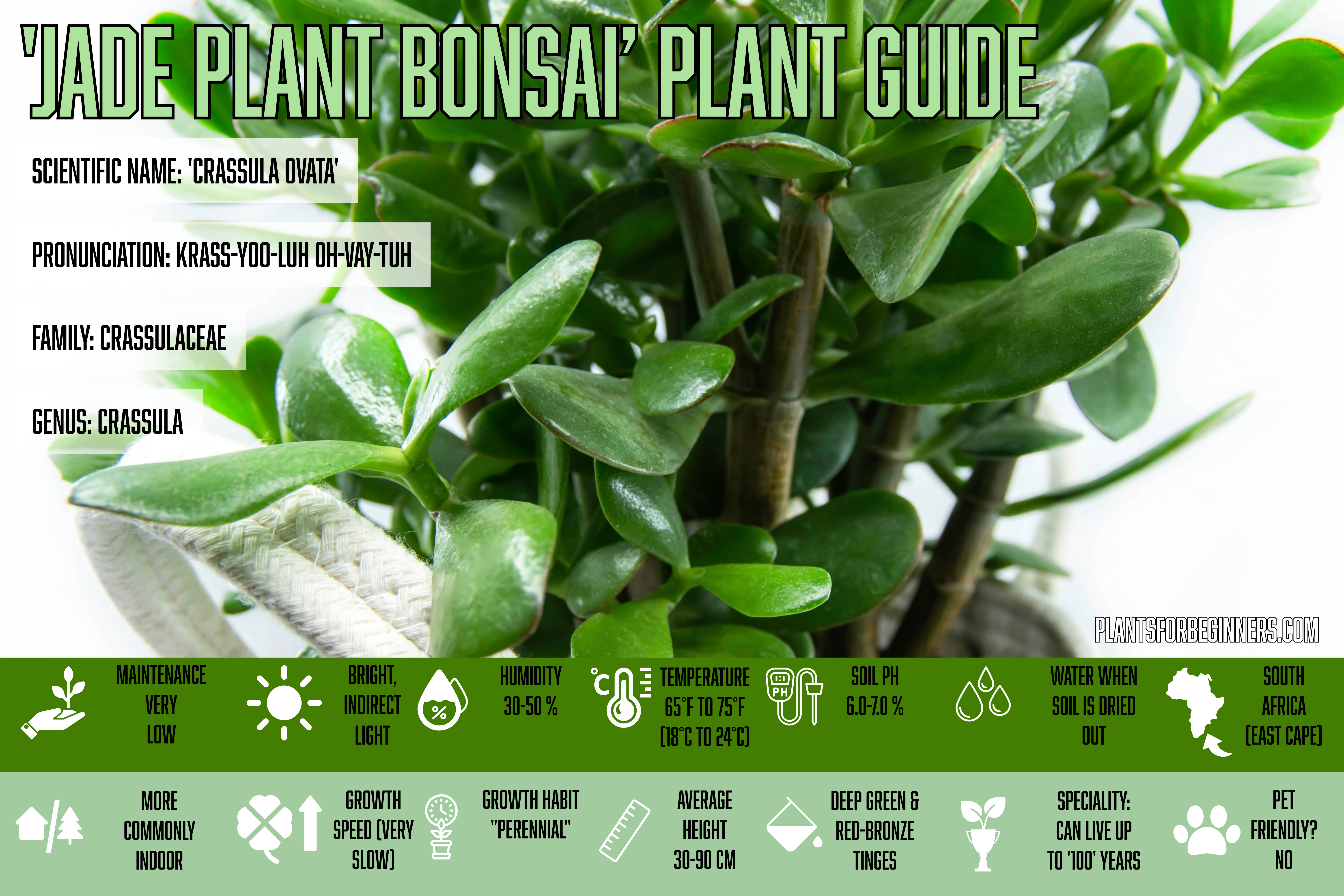
| Binomial Plant Name: | Crassula ovata (Jade Plant Bonsai) |
| Type: | Succulent |
| Genus: | Crassula |
| Pronounciation: | KRASS-yoo-luh oh-VAY-tuh |
| Meaning Behind Name: | Named after Baron Walter von Saint Paul-Illaire, who discovered the plant in Tanzania. |
| Nicknames: | Jade Tree, Money Plant, Lucky Plant |
| Commonly Confused With: | Crassula argentea (Silver Dollar Plant), which has rounder leaves compared to the more elongated leaves of Crassula ovata. |
| Variants of Plant: | There are several cultivars of Crassula ovata, including ‘Hummel’s Sunset,’ ‘Gollum,’ and ‘Tricolor,’ each with unique leaf colors and shapes. |
| Temperature: | 65°F to 75°F (18°C to 24°C) |
| Light | Bright and Indirect light |
| Watering: | Allow the soil to dry out between waterings. |
| Humidity: | low to moderate humidity levels, typically between 30% and 50%. |
| Soil PH: | slightly acidic to neutral, ranging from 6.0 to 7.0 |
| Blooming Season: | Typically blooms in late winter to early spring |
| Lifespan: | Several years – 75+ years |
| Growth Speed: | Very slow, typically growing 2-4 inches per year. |
| Pet Friendly: | No |

Plant Overview: Jade Plant Bonsai
The Jade Plant Bonsai (Crassula ovata) is a miniature tree form known for its thick, woody trunks and plump, teardrop-shaped leaves that naturally store water. Highly regarded by beginners for its incredibly resilient nature, this South African succulent brings an ancient, architectural aesthetic to indoor spaces without the fragile demands of traditional bonsai trees. Because it grows at a manageable pace and tolerates periods of dry soil, it is the perfect introduction for aspiring bonsai hobbyists looking for a visually striking desk plant that forgives occasional forgetful watering.

Beyond its striking appearance and easy care, this resilient succulent carries a rich cultural legacy that elevates its appeal in modern homes. Often referred to as the “Money Tree” or “Friendship Tree” in Feng Shui traditions, it is widely believed to attract positive energy, prosperity, and financial success when positioned near a home’s entrance or in a southeastern room. As a slow-growing specimen, the jade plant naturally responds beautifully to shallow training pots, making it incredibly easy for absolute beginners to develop a dramatic, aged canopy over time without the complex structural demands of traditional trees. It offers the perfect canvas for creative plant parents to practice gentle branch shaping, wiring, and compact canopy design right on their desks.
Native Climate & Indoor Placement: Jade Plant Bonsai
To successfully grow a jade plant bonsai indoors, you must replicate the arid, sun-drenched hillsides of its native South Africa. In their natural habitat, these succulents survive on rocky slopes exposed to intense, direct sunlight and prolonged dry spells. Translating these environmental conditions into a household setting means that placement is the single most important factor for your bonsai’s health.

The ideal indoor location is a South or West-facing window sill. These areas receive the highest volume of bright, direct sunlight necessary to prevent the plant’s branches from becoming weak, leggy, and stretched out. If a southern exposure is not available, an East-facing window that catches intense morning sun is a suitable alternative.
Temperature consistency is equally critical. Jade plant bonsais thrive in standard household temperatures between 18°C and 24°C (65°F to 75°F) during the daytime. Because they are native to warm climates, they have zero frost tolerance. Keep your bonsai completely isolated from chilly winter window drafts, air conditioning vents, and sudden temperature drops, as freezing temperatures will cause the water-filled leaves to rupture and drop off.
Care & Seasonal Maintenance: Jade Plant Bonsai
Caring for a jade plant bonsai requires shifting your routine based on the plant’s seasonal biological clock. Because it is a succulent, its metabolic needs change drastically between its active growing period and its winter rest phase.
Never water your jade bonsai on a fixed calendar schedule. Instead, allow the potting medium to dry out 100% from top to bottom before adding moisture. To test this, push a wooden chopstick deep into the pot; if it comes up completely dry with no dark soil clinging to it, the plant is ready for water. When you do water, drench the soil thoroughly until water pours freely out of the bottom drainage holes. This mimics natural desert rainstorms and encourages deep, healthy root systems.

Lighting Thresholds
While placement near a bright window is essential, monitor the leaves to ensure the light intensity is correct. Healthy jade bonsais receiving optimal light will develop a vibrant, deep green coloration with subtle reddish tips on the leaf margins. If the leaves turn pale green and the space between new leaves becomes long and thin, the plant is starving for light. Conversely, if you notice chalky, papery brown patches on the foliage, the plant is experiencing sunburn from a sudden increase in intense midday sun.
Seasonal Adjustments
- Autumn and Winter (Dormancy): As daylight hours shorten, the jade plant enters a semi-dormant state. Cut your watering frequency in half, allowing the plant to sit in dry soil for a week or two before watering again. Completely halt all fertilization during these cold months, as forcing new growth in low light results in weak, spindly branches that ruin the bonsai’s compact shape.
- Spring and Summer (Active Growth): This is when your bonsai requires the most energy. Water it as soon as the soil dries out, and feed it once a month with a balanced, organic fertilizer diluted to half-strength to support new leaf growth and trunk thickening.
Step-by-Step Repotting Guide: Jade Plant Bonsai
Repotting a jade plant bonsai is completely different from repotting a standard houseplant. Instead of simply moving it to a larger container, bonsai repotting focuses on maintaining a compact root system so the plant can thrive in a shallow, artistic ceramic pot. Young jades should be repotted every two years in the spring, while mature specimens can remain in the same container for up to five years.
The Ultimate Gritty Soil Mix
Standard potting soil retains far too much moisture, which quickly suffocates jade roots. To ensure rapid drainage and maximum root aeration, mix your own substrate using the following volume ratios:
- 1 Part Pumice or Perlite: Provides essential air pockets and structures the soil.
- 1 Part Lava Rock (Sieved): Retains trace nutrients without trapping stagnant water.
- 1 Part Akadama or Calcined Clay: Holds just enough moisture to keep the plant hydrated.

How to Repot Your Bonsai
Post-Repot Recovery: Lightly mist the surface of the soil, but do not give it a heavy watering for at least 7 to 10 days. This dry period allows the freshly cut roots to form a protective callus, preventing soil-borne fungi from attacking the open wounds. Keep the plant in bright, indirect light away from harsh wind during this recovery phase.
- Dry the Soil: Do not water your jade for one full week before repotting. Dry soil pulls away cleanly from the roots and makes the process significantly easier.
- Unhouse the Plant: Gently slide the jade out of its pot. Use a root rake or a chopstick to carefully comb out the old soil from the outer edges of the root ball.
- Prune the Roots: Use sterilized bonsai shears to cut away thick, downward-growing taproots. Focus on keeping the fine, fibrous feeder roots. You can safely remove up to one-third of the total root mass to encourage a flat, radial root system.
- Prepare the New Pot: Place fine plastic mesh over the drainage holes of your shallow bonsai pot to prevent the gritty soil from falling through.
- Secure and Fill: Position the tree slightly off-centre in the pot for a traditional aesthetic. Secure the trunk using anchor wires threaded through the bottom of the pot. Pour your gritty soil mix around the roots, using a chopstick to gently poke the soil down into any empty air pockets.
Step-by-Step Propagation Guide: Jade Plant Bonsai
One of the greatest benefits of the jade plant bonsai is how effortlessly it multiplies. You can easily grow entirely new miniature trees using the branches you remove during seasonal styling and pruning. While propagation is highly successful, you must follow the correct drying process to prevent the cuttings from rotting before they can grow roots.
Method 1: Stem Cuttings (Fastest Results)
Stem cuttings give you a massive head start because you are starting with a thick, established branch that already looks like a miniature tree trunk.
Take the Cut: Select a healthy, woody branch with at least two or three leaf clusters. Use a sharp, sterilized blade to make a clean cut right below a leaf node (the ring where leaves connect to the stem).
Let It Callus: Place the cutting in a dry, shaded area for 3 to 5 days. The raw, wet cut must dry out and form a hard, light-coloured skin (callus). Planting a wet cutting directly into soil introduces bacteria that will instantly rot the stem.
Plant the Cutting: Once callused, insert the bottom inch of the stem into a small pot filled with a damp mix of 50% peat moss and 50% perlite. Do not push the cutting down too hard; gently firm the mix around it so it stands upright.
Rooting Care: Place the pot in a warm spot with bright, indirect light. Do not water it for the first week. After seven days, begin misting the soil lightly when it feels dry. New roots will form within 3 to 4 weeks, which you can verify by giving the stem a very gentle upward tug; if you feel resistance, roots have successfully anchored.

Method 2: Leaf Propagation (The Patient Approach)
If you accidentally knock a single leaf off your bonsai during wiring or handling, you can use it to grow a brand-new plant from scratch.
Ensure a Clean Pull: Gently twist a healthy leaf off the main trunk. The entire base of the leaf must come off cleanly in one piece. If the leaf snaps in half, it will not propagate.
Air-Dry: Leave the leaf on a dry paper towel in indirect light for 2 to 3 days until the broken tip calluses over.
Lay on Soil: Place the leaf flat on top of a tray filled with succulent soil. Do not bury the leaf.
Watch for Pups: Leave the tray in bright, indirect light and completely ignore it. Do not water it. Within a month, the leaf tip will spontaneously sprout tiny pink roots and a miniature cluster of new baby leaves (a “pup”). Once roots appear, mist the soil surface once a week. The original mother leaf will eventually shrivel up and fall away on its own, leaving behind a perfect independent jade plant.
Identification & Treatment of Common Pests: Jade Plant Bonsai
Because jade plant bonsais store high volumes of water in their leaves and stems, health issues manifest rapidly through visual changes in the foliage. Diagnosing these symptoms early is critical to saving your tree from long-term structural damage.
Visual Symptom Table
| What You See | The Underlying Issue | The Instant Fix |
|---|---|---|
| Wrinkled, puckered leaves | The plant is severely dehydrated. | Give the soil a deep, thorough watering immediately. |
| Yellow, translucent, mushy leaves | The roots are drowning from overwatering. | Stop watering immediately and check the pot drainage. |
| Sudden, heavy leaf drop | The plant is in a freezing draft or starved for light. | Move the bonsai to a warmer, sunnier location. |
| Long, thin branches with pale growth | The plant is stretching out to find light (etiolation). | Move the pot directly into a South or West-facing window. |
| Chalky, papery brown spots | The foliage has been sunburned by sudden intense sun. | Provide light shade during the absolute peak afternoon hours. |

Identification & Treatment of Common Pests
Mealybugs (Cotton-Like Spots): These are the most common jade pests. They look like tiny, white, fuzzy cotton balls clustering underneath leaf joints and along the stems. They suck the sap out of the plant, crippling new growth.
- The Fix: Dip a cotton bud into 70% isopropyl rubbing alcohol and dab it directly onto each individual bug to kill them instantly. For severe infestations, spray the entire plant with a diluted organic insecticidal soap. Never use heavy chemical sprays, as jade leaves are highly sensitive to synthetic oil inputs.
Spider Mites (Fine Webbing): If you notice ultra-fine, dusty webs stretching between the branches, your bonsai has spider mites. They thrive in warm, bone-dry household air.
- The Fix: Take the bonsai to a sink and thoroughly wash down the foliage with a gentle stream of lukewarm water to knock the mites loose. To prevent their return, increase the airflow around the plant and lightly mist the air around the pot during dry winter months.
Root Rot (Black, Soft Trunk Base): If the very base of the trunk turns black, soft, and slimy, fungal rot has traveled up from the suffocated root system.
- The Fix: This is an emergency. Unpot the tree, cut away all black, slimy roots using sterilized shears, and clean the trunk base. If the trunk itself is entirely mushy, your only option is to chop the top healthy branches off and restart them as brand-new stem cuttings using the propagation steps outlined above.
Recommended Tools & Gear: Jade Plant Bonsai
Caring for a miniature tree requires a few specialized inputs that you cannot find in a standard garden center. Equipping yourself with the right tools ensures precise cuts and proper soil conditions, preventing accidental damage to your bonsai.

- Carbon Steel Bonsai Shears: Standard kitchen scissors crush the delicate internal tissues of jade branches when making a cut. A dedicated pair of razor-sharp, narrow bonsai shears allows you to make clean, flush cuts right at the leaf nodes, which speeds up the plant’s natural callusing process and prevents die-back.
- A Pre-Mixed Gritty Succulent Substrate: If you do not want to source raw components like Akadama and volcanic lava rock individually, look for a premium commercial “Bonsai Gritty Mix.” Ensure the bag consists of 100% aggregate materials with zero added compost or soil peat, guaranteeing maximum oxygen flow to the root ball.
- Shallow Ceramic Training Pots with Built-In Wire Anchor Holes: Traditional terracotta pots rarely have secondary holes at the bottom base. A true ceramic bonsai pot features dedicated micro-holes next to the main drainage openings, allowing you to easily thread your trunk anchor wires through to keep your jade stable while it roots.
- A Digital Moisture Meter: If you are nervous about using the chopstick test to measure when the soil is 100% dry, a physical moisture meter probe takes away all the guesswork. Insert the metal probe down to the very bottom of your bonsai pot; you should only water your jade when the digital display needle drops completely into the dry zone.
Frequently Asked Questions: Jade Plant Bonsai
A standard jade plant cutting can take 3 to 5 years of consistent pruning and trunk training to develop the thick, woody base and compact canopy characteristic of a classic bonsai. To accelerate this look, plant your jade in a larger training pot for the first two years to let the trunk thicken rapidly before moving it into a shallow, restrictive ceramic bonsai pot.
Yes, according to the ASPCA, all parts of the Crassula ovata species are highly toxic to pets. Ingesting the fleshy leaves or sap can cause vomiting, depression, and a slow heart rate (bradycardia) in cats and dogs. Always place your bonsai on high shelves or inside a plant cabinet completely out of reach of household animals.
Sudden drop of healthy green leaves is almost always caused by an environmental shock—most commonly a sudden temperature drop or cold draft. If the plant is exposed to temperatures below 10°C (50°F), or if it is sitting directly in front of an air conditioning vent, its defensive response is to drop foliage. Move it immediately to a warm, stable room.
No, you should only use aluminum bonsai training wire. Jade branches are exceptionally soft, fleshy, and easily bruised. Heavy copper wire is too rigid and can easily slice through the water-filled bark when bent. Wrap branches loosely with paper-wrapped or anodized aluminum wire, and remove it within 6 weeks to prevent it from scarring the fast-growing bark.
Citations and References: Jade Plant Bonsai
- The official botanical taxonomy and native South African arid habitat parameters for Crassula ovata are documented by the Royal Botanic Gardens, Kew.
- The specific “soak and dry” watering mechanics, temperature thresholds, and environmental requirements are certified by the University of Connecticut Extension and the Wisconsin Horticulture Extension.
- The specialized bonsai repotting steps, root-pruning tolerances, and aggregate gritty soil mix ratios are sourced from Bonsai Empire.
- The stem and leaf propagation timelines, tissue callusing requirements, and substrate rooting protocols are backed by the University of California Agriculture and Natural Resources Extension.
- The pest management workflows detailing mealybug removal using 70% isopropyl alcohol and treatments for root rot are validated by the PennState Extension.
- The veterinary safety alerts proving that jade plant ingestion causes vomiting and depression in cats and dogs are certified by the ASPCA Toxic and Non-Toxic Plants Database.